


Understanding Identity Theft Charges in South Carolina
Identity theft charges in South Carolina carry serious legal consequences that can impact your future for years. The state prosecutes these crimes aggressively, with penalties ranging from substantial fines to lengthy prison sentences.
We at Hays Cauley, P.C. see how these accusations can devastate lives and careers. Understanding your rights and available defenses becomes vital when facing such charges.
Types of Identity Theft Charges in South Carolina
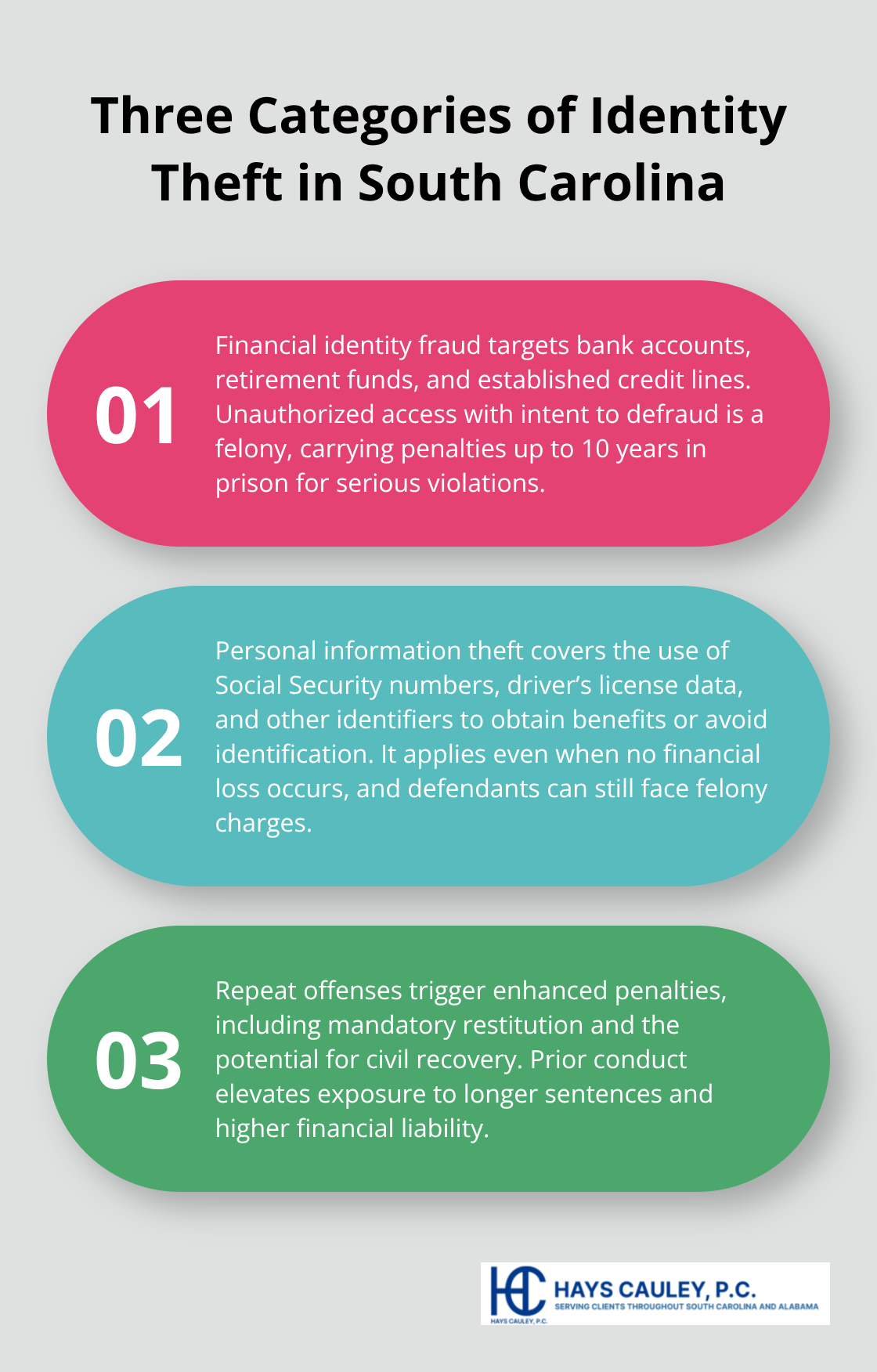
South Carolina Code Section 16-13-510 establishes three distinct categories of identity theft charges that prosecutors pursue with determination. Financial identity fraud carries the harshest penalties, with offenders who face up to 10 years in prison for unlawful access to another person’s financial resources (bank accounts, retirement funds, and credit lines). The Federal Trade Commission reports that over 14 million Americans experience identity theft annually, with victims who collectively lost more than $52 billion in 2022.
Financial Identity Fraud and Credit Card Violations
Courts classify financial identity fraud as a felony when defendants unlawfully appropriate another person’s financial resources with intent to defraud. This charge applies to unauthorized access to checking accounts, savings accounts, retirement funds, and established credit lines. Prosecutors must prove intent to defraud, but they do not need to demonstrate actual financial loss occurred. The law covers digital signatures, bank account numbers, and credit card details as protected financial information.
Personal Information Theft Without Financial Loss
Personal information theft involves the use of someone’s Social Security number, driver’s license details, bank account numbers, or credit card information to obtain employment or avoid law enforcement identification. This charge applies even when no financial loss occurs to the victim. The statute protects various forms of personal data including dates of birth, addresses, and telephone numbers. Defendants face felony charges regardless of whether they profited from the stolen information.
Enhanced Penalties for Repeat Offenses
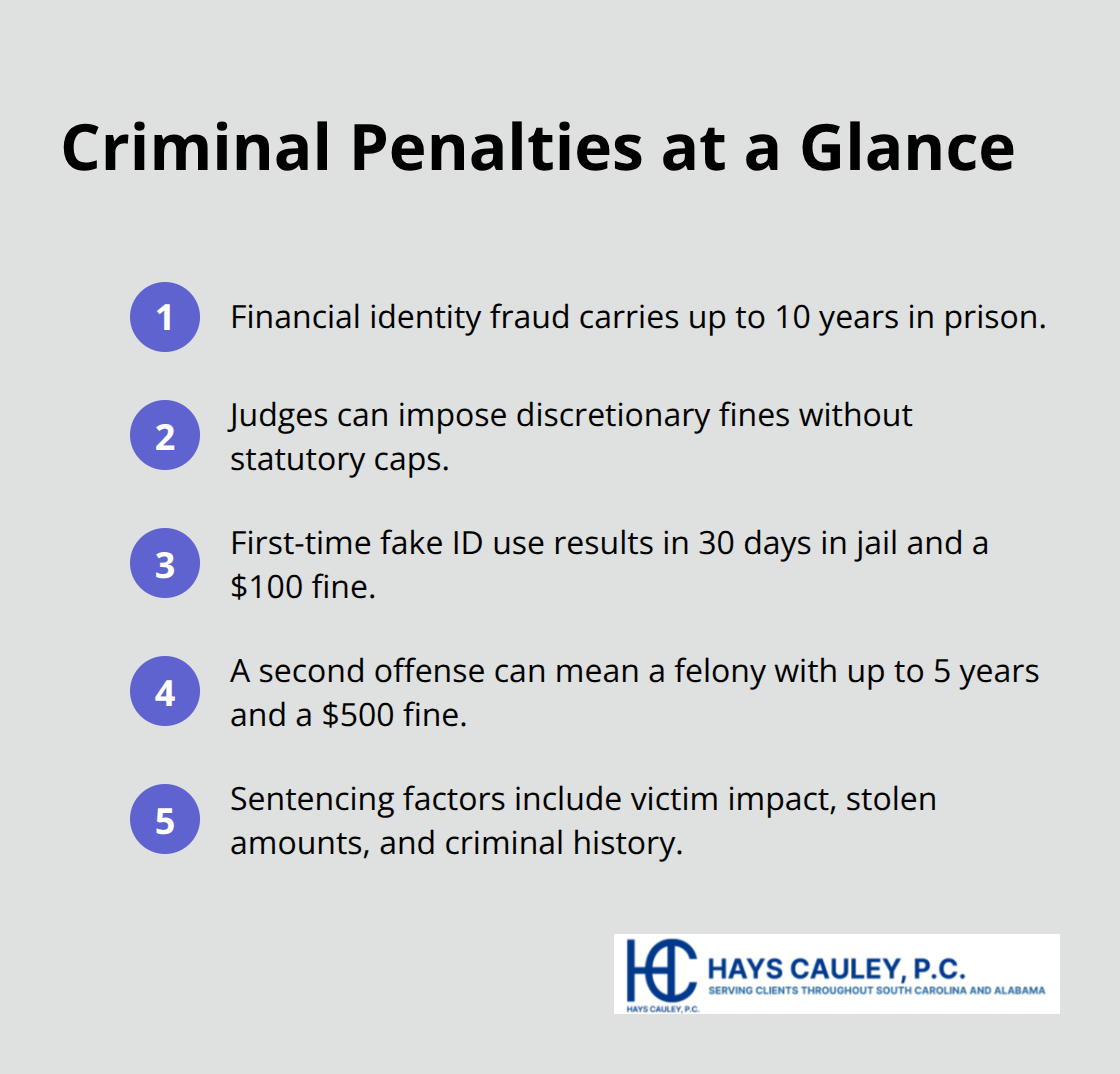
South Carolina treats repeat identity theft offenses as felonies with mandatory enhanced penalties. First-time offenders who use fake identification for illegal activities face 30 days in jail and $100 fines, while second offenses escalate to felonies with up to 5 years imprisonment and $500 fines. Courts must order restitution under Section 17-25-322, which requires defendants to restore victims to their pre-fraud financial status. The State Law Enforcement Division maintains confidential records of identity theft victims, which supports civil claims where victims can recover three times actual damages or $3,000 per incident under Section 37-20-170.
Prosecution Venue and Jurisdiction Authority
Prosecutors can file charges in either the county where the victim resided or where defendants obtained or used the fraudulent information. South Carolina law specifically states that prosecutors need not prove all criminal acts occurred within state boundaries, which makes prosecution easier for cases that involve multiple jurisdictions. Law enforcement must accept police reports of identity theft regardless of location or amount involved. Victims who document theft within 30 days resolve fraudulent debt 85% faster according to the South Carolina Department of Consumer Affairs. These procedural advantages give prosecutors significant flexibility in how they pursue cases, which directly impacts the penalties defendants may face.
Legal Consequences and Penalties for Identity Theft
Identity theft convictions in South Carolina trigger severe financial and personal consequences that extend far beyond initial court proceedings. Courts impose prison sentences up to 10 years for financial identity fraud under Section 16-13-510, while fines reach discretionary amounts that judges determine based on case severity and defendant financial capacity. The Federal Trade Commission data shows victims spend an average of $1,300 in out-of-pocket costs to resolve identity theft issues, but defendants face exponentially higher financial burdens through court-ordered restitution, legal fees, and lost income during incarceration.
Criminal Penalties Include Prison Time and Substantial Fines
South Carolina courts hand down felony sentences that carry maximum prison terms of 10 years for financial identity fraud cases. Judges possess discretionary authority to impose fines without statutory limits, which means defendants face potentially unlimited financial penalties based on case circumstances. First-time offenders who use fake identification for illegal activities receive 30 days in jail and $100 fines, while second offenses escalate to felonies with up to 5 years imprisonment and $500 fines. Courts consider factors such as victim impact, stolen amounts, and criminal history when they determine final sentences.
Mandatory Restitution and Financial Recovery Requirements
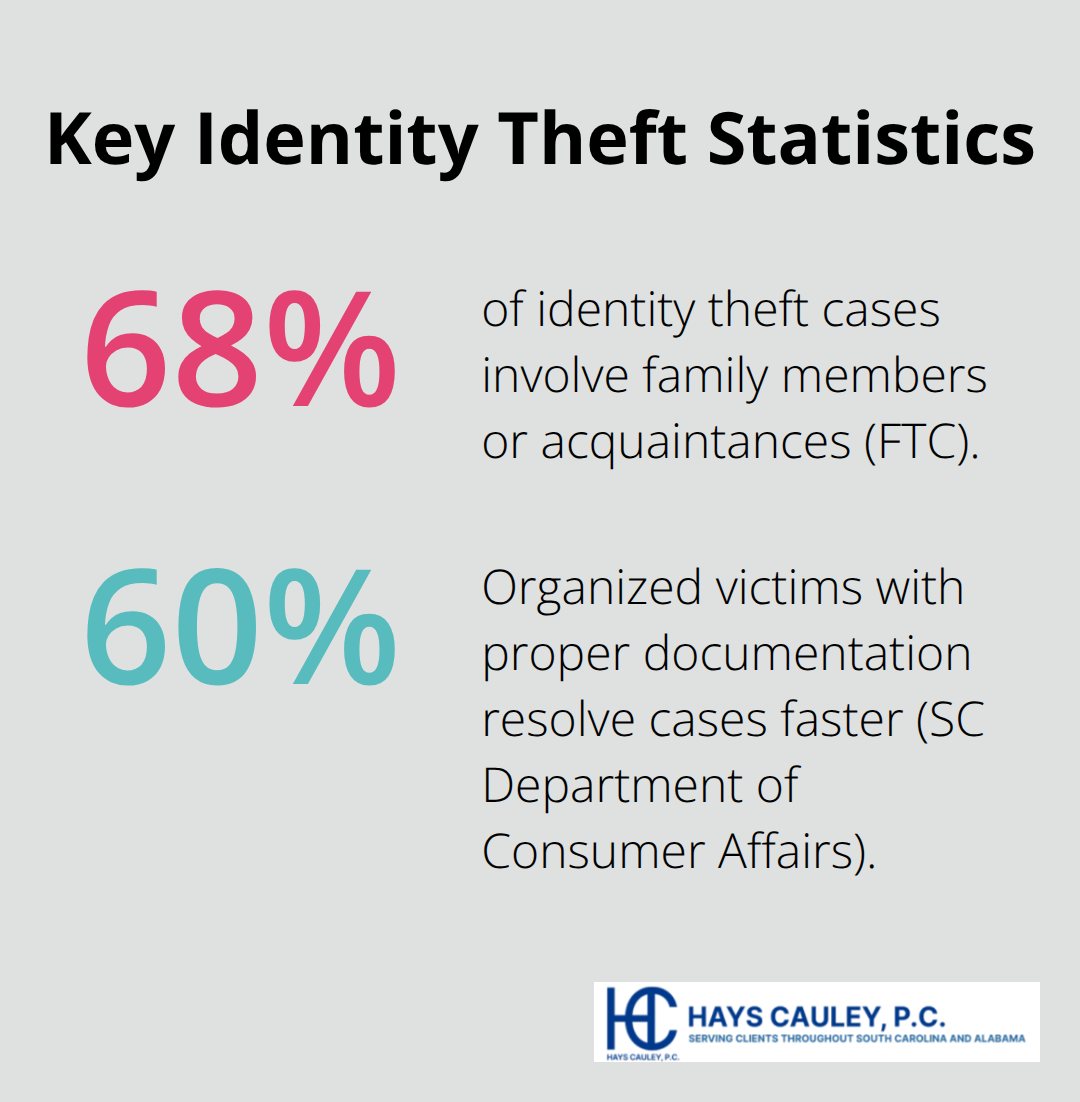
South Carolina law mandates full restitution to victims under Section 17-25-322, which requires defendants to restore victims to their exact pre-fraud financial position. Courts calculate restitution amounts that include stolen funds, fraudulent charges, credit monitoring costs, and documented time losses at minimum wage rates. Section 37-20-170 allows victims to pursue civil damages of three times actual losses or $3,000 per incident, which creates potential liability that reaches tens of thousands of dollars for single cases. The South Carolina Department of Consumer Affairs reports that organized victims with proper documentation resolve cases 60% faster, and this directly impacts final restitution calculations that defendants must pay.
Permanent Criminal Records Destroy Employment Opportunities
Identity theft felony convictions create permanent criminal records that appear in background checks for employment, housing, and professional license applications. Employment opportunities suffer immediate and lasting damage, as many employers automatically reject applicants with fraud convictions regardless of circumstances or time elapsed. Professional licenses in finance, healthcare, education, and legal fields face suspension or permanent revocation after identity theft convictions. The Identity Theft Resource Center confirms that conviction consequences persist indefinitely and affect career advancement, security clearances, and business ownership opportunities throughout defendants’ working lives.
Long-Term Social and Financial Impact
Courts may order asset forfeiture under Section 16-13-275, which allows law enforcement to seize property connected to identity theft crimes. Credit scores suffer permanent damage that affects loan approvals, mortgage applications, and rental agreements for decades after conviction. Defendants lose voting rights during incarceration periods and face restrictions on firearm ownership that continue after release. Civil judgments that include attorney fees often reach $25,000-$50,000 in total, making identity theft an expensive crime with consequences that last decades. These collateral consequences compound the direct penalties and create barriers that affect defendants’ ability to rebuild their lives after they complete their sentences.
How Can You Fight Identity Theft Charges
Identity theft accusations require immediate and strategic legal action that focuses on challenging prosecution evidence and establishing reasonable doubt. South Carolina prosecutors must prove intent to defraud beyond reasonable doubt, which creates multiple defense opportunities when defendants act quickly with proper legal representation. The burden of proof lies entirely with the state, and successful defenses often center on mistaken identity, lack of criminal intent, or insufficient evidence that links defendants to alleged crimes.
Challenge Intent and Knowledge Elements
Prosecutors must demonstrate that defendants knowingly used another person’s information with specific intent to defraud, which creates significant defense opportunities in cases where evidence shows accidental use or legitimate authorization. Many identity theft cases involve shared computers, family members with similar names, or employees who accessed information as part of legitimate job duties. The Federal Trade Commission reports that 68% of identity theft cases involve family members or acquaintances, which means defendants often possess legitimate explanations for access to personal information.
Defense attorneys focus on proof that defendants lacked criminal intent by showing they believed they had permission to use the information or that they received information through legitimate channels. Courts require prosecutors to prove defendants acted with specific knowledge that their conduct was unlawful, and this element becomes difficult to establish when defendants can show reasonable belief in their authorization.
Demand Complete Evidence Chain and Documentation
South Carolina law requires prosecutors to establish clear connections between defendants and alleged criminal acts through documented evidence chains that prove defendants actually used stolen information. Defense attorneys examine credit card statements, bank records, computer logs, and witness testimony for gaps or inconsistencies that create reasonable doubt about defendant involvement. The State Law Enforcement Division maintains identity theft victim records, but prosecutors must still prove defendants committed specific acts rather than simply possessed information.
Successful defenses often challenge the timing of alleged crimes, question witness identification accuracy, and demand proof that defendants personally conducted fraudulent transactions rather than third parties who may have accessed the same information. Courts require prosecutors to present evidence that directly links defendants to each element of the charged crime, and missing documentation frequently results in case dismissals or reduced charges when defense attorneys properly challenge incomplete evidence presentations.
Attack Witness Credibility and Identification
Identity theft cases often rely on witness testimony from victims, bank employees, or store clerks who claim to identify defendants during fraudulent transactions. Defense attorneys challenge these identifications by examining lighting conditions, distance factors, time delays between incidents and identification procedures, and witness stress levels during alleged crimes. Studies show that cross-racial identification accuracy drops significantly under stress (with error rates exceeding 40% in some circumstances), which creates substantial doubt about witness reliability.
Defense teams also examine whether witnesses had adequate opportunity to observe defendants, whether they were distracted during alleged incidents, and whether law enforcement used proper identification procedures. Courts recognize that mistaken identification represents a leading cause of wrongful convictions, and judges often exclude unreliable witness testimony when defense attorneys properly challenge identification procedures and circumstances.
Final Thoughts
South Carolina treats identity theft charges as serious felonies that carry prison sentences up to 10 years and unlimited fines at court discretion. The state’s comprehensive laws under Section 16-13-510 cover financial fraud, personal information theft, and enhanced penalties for repeat offenses. Prosecutors possess significant advantages through flexible venue options and reduced burden requirements, which makes these cases particularly difficult to defend.
The prosecution must prove intent to defraud beyond reasonable doubt, which creates defense opportunities through challenges to evidence chains, witness credibility, and criminal intent elements. Constitutional rights protect defendants throughout the legal process, and quick action with proper legal representation significantly impacts case outcomes and potential penalties. Courts require prosecutors to establish clear connections between defendants and alleged criminal acts through documented evidence.
We at Hays Cauley, P.C. understand the devastating impact these charges create on your future employment, financial stability, and personal reputation (including damaged credit scores that persist for years). Our firm focuses on consumer protection law and helps individuals navigate credit reporting, identity theft, and debt-related legal issues. If you face identity theft charges in South Carolina, contact Hays Cauley, P.C. immediately to protect your rights and explore available defense strategies before you speak with law enforcement or prosecutors.