


Securing SC Credit Report Accuracy: What You Should Know
Your credit report directly affects your ability to borrow money, rent an apartment, and even get hired for jobs. Errors on your report can cost you thousands in higher interest rates or denied applications.
At Hays Cauley, P.C., we help South Carolina residents fix inaccurate information and protect their financial futures. This guide walks you through your rights and the concrete steps to achieve SC credit report accuracy.
Understanding Credit Report Errors in South Carolina
What Credit Report Errors Actually Look Like
Credit report errors fall into distinct categories, and understanding them helps you spot problems faster. Unfamiliar accounts represent the most damaging type-fraudulent or misreported accounts that appear on your file without your authorization. The Federal Trade Commission reported over 175,000 credit-reporting complaints in 2020, with unfamiliar accounts driving a significant share. These accounts can stay on your report for seven years if not corrected, which is why speed matters. Duplicate accounts distort your credit utilization ratio by showing the same debt twice, artificially inflating the percentage of credit you’re using. Incorrect payment histories are equally destructive; even a single late mark stays for seven years and can raise your interest rates substantially. According to the Consumer Financial Protection Bureau, roughly one in five South Carolina consumers face payment history errors. Personal information mistakes and address discrepancies create a different problem-they hinder identity verification and risk mixing your file with someone else’s (a critical issue since South Carolina ranks 13th in identity theft reports per 100,000 residents).
How Errors Crater Your Finances
The financial damage from inaccurate credit reports is quantifiable and severe. Moving from a 750 credit score to a 620 score due to errors can raise mortgage costs by approximately two percentage points-potentially costing you around $200,000 more 30 years on a $300,000 loan. Employers, landlords, and insurance companies all check your credit in South Carolina, so errors affect housing approvals, job prospects, and insurance rates simultaneously. The CFPB notes that about 70 percent of disputes result in some modification to the credit report, meaning errors are fixable but only if you act. Inaccurate items compound quickly because they damage multiple areas of your financial life at once. Late payments tank your score fastest since payment history comprises about 35 percent of most scoring models. High utilization caused by duplicate accounts can suppress your score by 50 to 100 points within months. The longer errors sit uncorrected, the more financial damage accumulates.
Why Bureaus Make These Mistakes
Credit reporting agencies compile data from thousands of creditors and furnishers daily, and the volume creates systematic problems. Merging consumer files happens regularly-lenders report information using inconsistent identifiers, and bureaus sometimes match names, addresses, or dates of birth incorrectly. Furnishers themselves supply wrong data; creditors may report accounts under variations of your name or fail to update payment status promptly. South Carolina law requires bureaus to reinvestigate disputed items within 30 days at no cost to you, but many disputes get rejected because the investigation is cursory or incomplete. The scale matters: South Carolina alone saw 20,406 complaints about incorrect information and more than 45,000 overall credit-reporting complaints according to CFPB data. This volume means errors are inevitable, but it also means bureaus have resources and legal obligations to fix them when you demand verification. Once you understand what errors look like and why they happen, the next step is learning what protections the law gives you to correct them.
Your Rights Under Federal and South Carolina Law
What the Fair Credit Reporting Act Requires
Federal law under the Fair Credit Reporting Act gives you concrete rights that credit bureaus must follow, and South Carolina adds additional protections on top.
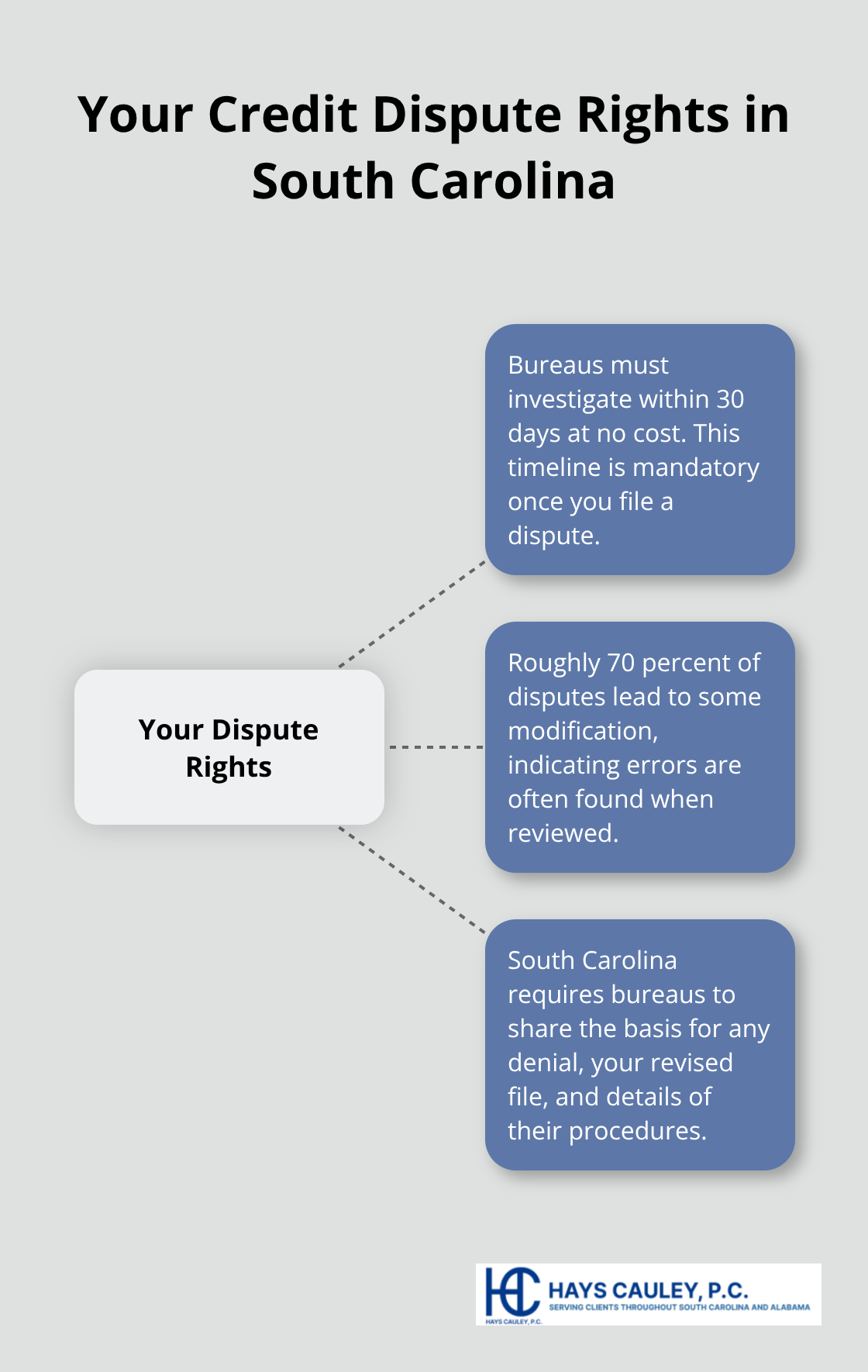
When you file a dispute, the bureau must investigate your claim within 30 days at no cost to you-this is non-negotiable. The CFPB reports that roughly 70 percent of disputes result in some modification to your credit report, which means bureaus frequently find errors once they actually look. South Carolina law requires bureaus to provide you with the basis for their denial if they reject your dispute, a copy of your revised file showing corrections, and a detailed description of their investigation procedure. This transparency requirement matters because it forces bureaus to document their work instead of ignoring your complaint.
Penalties for Bureau Violations
If a bureau fails to investigate properly or ignores a verified error, South Carolina law allows you to sue for actual damages plus statutory damages of at least $1,000 per violation. Willful violations-where a bureau knowingly breaks the rules-can result in triple your actual damages or up to $3,000 per incident, with the bureau potentially covering your attorney fees. The CFPB returned approximately $17.5 billion to wronged consumers nationwide through enforcement actions, demonstrating that taking action produces real monetary relief. If a judgment orders the bureau to remove an item within 10 days and they fail to comply, damages can accrue at $1,000 per day.
How to Build Your Paper Trail
You must send your dispute by certified mail with return receipt to create documented proof that the bureau received your complaint-this paper trail becomes essential if you later need to prove the bureau ignored you. Include copies of supporting documents like bank statements or receipts, but never send originals. Circle the error on a copy of your report and attach it to your dispute letter. The 30-day investigation window is a hard deadline, not a suggestion; bureaus must provide results within five business days after the investigation concludes.
What Happens After Investigation
If 45 days pass and you hear nothing, send a follow-up certified letter referencing your original dispute date and demand a status update. After the investigation, inaccurate items disappear or get corrected-if the bureau verifies the item as accurate, you can add a dispute statement to your file explaining your position. South Carolina ranks 13th in identity theft reports per 100,000 residents, so these protections exist partly to address the heightened risk residents face when their credit files contain errors or fraudulent accounts. When disputes stall or creditors resist removal despite inaccurate information, a consumer protection attorney can help you pursue remedies under federal law and state protections. The next section walks you through the specific steps to obtain your free credit report and identify which errors demand immediate action.
Steps to Review and Correct Your Credit Report
Obtaining Your Free Credit Reports
Start at annualcreditreport.com, the only site authorized by federal law to provide free credit reports without upselling services or demanding personal information. You can request one report from each bureau or pull all three at once; the choice depends on your timeline. The three major credit reporting agencies-Equifax, Experian, and TransUnion-must provide these reports at no cost annually, and South Carolina residents receive an additional six free Equifax reports through 2026. Many people request one report every four months to monitor changes throughout the year, which catches fraud faster than waiting for an annual review.
Identifying Inaccuracies and Fraudulent Accounts
Once your reports arrive, create a separate file for each bureau and scan methodically for unfamiliar accounts, duplicate entries, late payments you didn’t make, misspellings of your name, and address discrepancies. Document every error with the creditor name, account number, description of the mistake, and the date you spotted it. Look especially hard for accounts you don’t recognize or entries marked late that you paid on time; these are the most financially damaging errors and warrant immediate action.
Filing Disputes With Credit Bureaus
Send written disputes to each bureau by certified mail with return receipt-do not call or email, as bureaus can ignore informal requests. On a copy of your credit report, circle each error and write a separate letter for each disputed item, explaining why it’s inaccurate and requesting removal or correction. Attach supporting documents like bank statements, cancelled checks, or receipts proving your position, but never mail originals. The bureau must investigate within 30 to 45 days at no cost and provide results within five business days after the investigation ends.
Tracking Results and Follow-Up Actions
The CFPB data shows roughly 70 percent of disputes result in some modification to your report, meaning errors are frequently fixable once bureaus actually examine them. If 45 days pass without a response, send a follow-up certified letter referencing your original dispute date and demand a status update. After the investigation, inaccurate items will be removed or corrected; if the bureau verifies the item as accurate despite your evidence, you can add a dispute statement to your file. When disputes stall or creditors resist removal, we at Hays Cauley, P.C. help South Carolina residents pursue remedies under federal law and state protections.
Final Thoughts
Your credit report shapes your financial life, and inaccurate information costs real money through higher interest rates, denied loans, and missed job opportunities. The steps outlined in this guide-pulling your free reports, documenting errors, and filing disputes by certified mail-put you in control of SC credit report accuracy. You have 30 days to act after spotting an error, and the law requires credit bureaus to investigate at no cost.
Most people see progress within six to twelve months when they combine dispute actions with disciplined financial behavior. Negative items drop off after seven years, and corrected information immediately improves your score and financial prospects. Automating payments, lowering credit utilization below 30 percent, and monitoring all three bureaus quarterly accelerate your recovery.
Some situations demand professional help. If a bureau ignores your dispute after 45 days, rejects your claim without proper investigation, or continues reporting inaccurate information despite your evidence, you need someone who understands the law and can force compliance. We at Hays Cauley, P.C. help South Carolina residents resolve credit reporting errors, identity theft, and debt-related challenges when disputes stall or creditors resist removal.