


Employment identity theft happens when criminals use your personal information to commit fraud related to your job or taxes. This type of theft can damage your credit, delay tax refunds, and create serious financial problems.
At Hays Cauley, P.C., we help South Carolina residents, including those in Greenville, Columbia and Charleston, understand and fight back against identity theft. This guide walks you through the warning signs, protection steps, and what to do if it happens to you.
What Is Employment Identity Theft: Serving South Carolina, Including Greenville, Columbia and Charleston
How Employment Identity Theft Works
Employment identity theft occurs when someone uses your Social Security number and personal details to secure a job in your name. Unlike financial identity theft, which targets bank accounts or credit cards directly, employment identity theft focuses on passing background checks and meeting employer eligibility requirements. Criminals exploit this method because they avoid immediate detection while establishing a work history under your identity.
The IRS and Social Security Administration track wages tied to your SSN, so when a thief works under your number, those earnings get reported to your account. This creates a cascading problem: fraudulent W-2s appear in your tax records, your Social Security benefits statement shows earnings you never made, and the IRS may send you notices about income discrepancies. Your employment history becomes contaminated with jobs you never held, background checks show inquiries from employers you never contacted, and your Social Security benefits can be reduced or delayed due to misattributed earnings.
How Criminals Obtain Your Information
Criminals typically obtain your information through data breaches, phishing emails, or stolen mail containing tax documents. Once they have your SSN and basic details, they apply for jobs at companies with weak verification processes. Some thieves use your information alongside a different name or photo on applications, counting on employers who conduct insufficient background checks. Others target industries with high turnover and minimal screening.
Red Flags That Signal Employment Identity Theft
The warning signs appear in specific places. If you receive a W-2 or 1099 from an employer you never worked for, that’s a red flag. An IRS notice about wages you didn’t earn, particularly a CP2000 notice, indicates someone reported income under your SSN. Background check inquiries from unfamiliar companies show up as soft pulls on your credit report. Receiving job offers or onboarding emails for positions you never applied to means someone is actively using your identity.
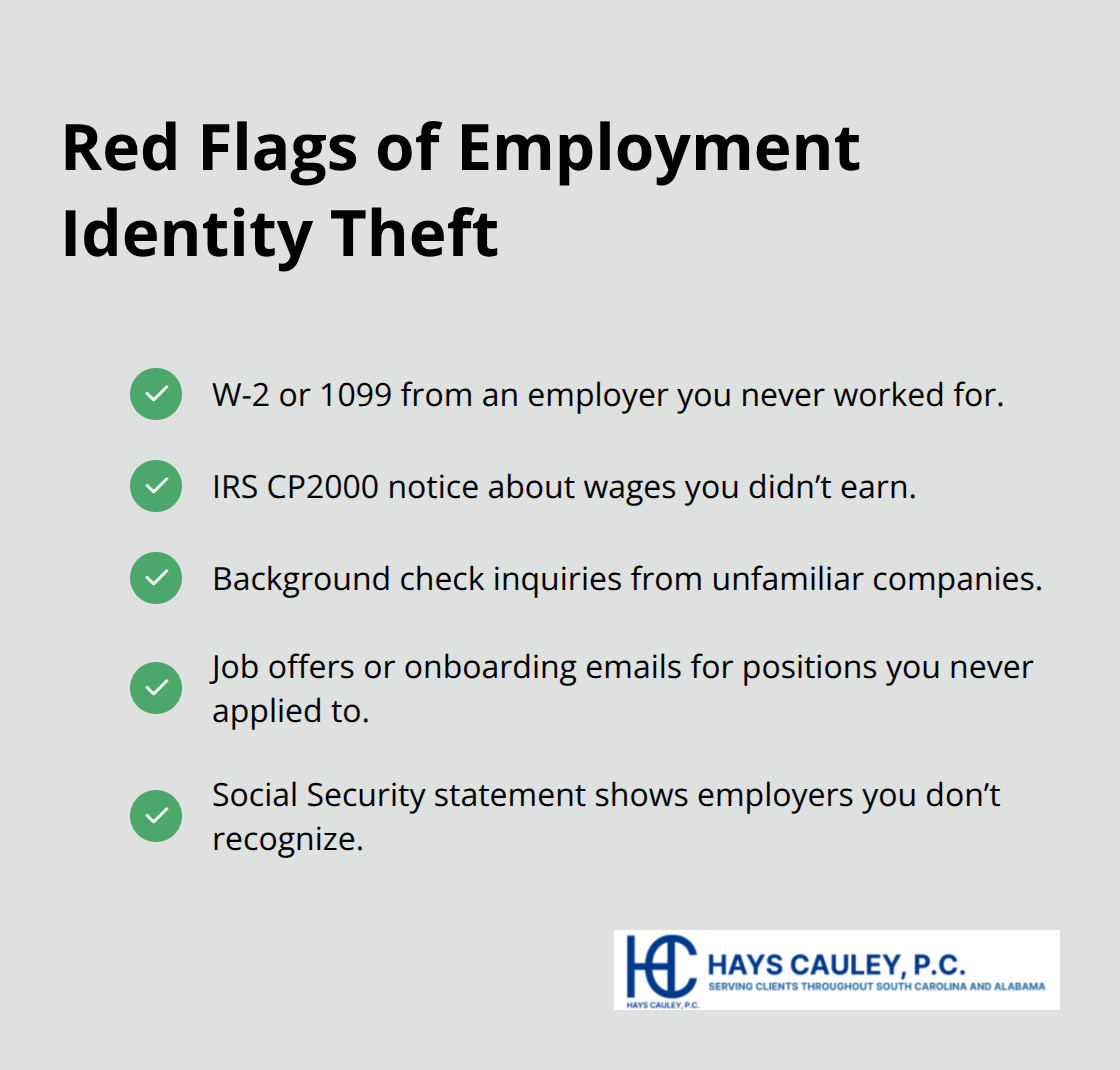
Your Social Security statement may show earnings from employers you cannot identify. Tax season amplifies these discoveries because that’s when victims typically file returns and notice discrepancies. The sooner you spot these signs, the faster you can contact the IRS at 1-800-908-4490 or the Social Security Administration at 1-800-269-0271 to halt further damage. Taking immediate action prevents additional fraudulent activity from compounding your problems.
How to Protect Your Employment Information
Secure Your Social Security Number
Your Social Security number acts as the master key to your identity, and criminals actively hunt for it. Stop carrying your SSN card in your wallet or purse-lock it in a safe at home instead. The Social Security Administration confirms that most employment identity theft starts with a stolen SSN, so physical security matters. Never write your SSN on forms unless absolutely required, and ask why organizations need it before providing it. When you do share your number, confirm you’re communicating with legitimate organizations through official phone numbers or websites, not contact information from emails or letters.
Data breaches happen constantly, so assume your information is already compromised somewhere. The Federal Trade Commission reports that data breaches exposed over 200 million consumer records in 2023 alone, making proactive monitoring your best defense.
Monitor Your Tax Records and Credit Reports
Your tax records and credit reports reveal employment identity theft faster than any other method. Pull your free annual credit report from AnnualCreditReport.com right now, and then stagger your requests throughout the year-one report every four months from each of the three bureaus. This strategy catches fraud early rather than waiting for annual reviews.
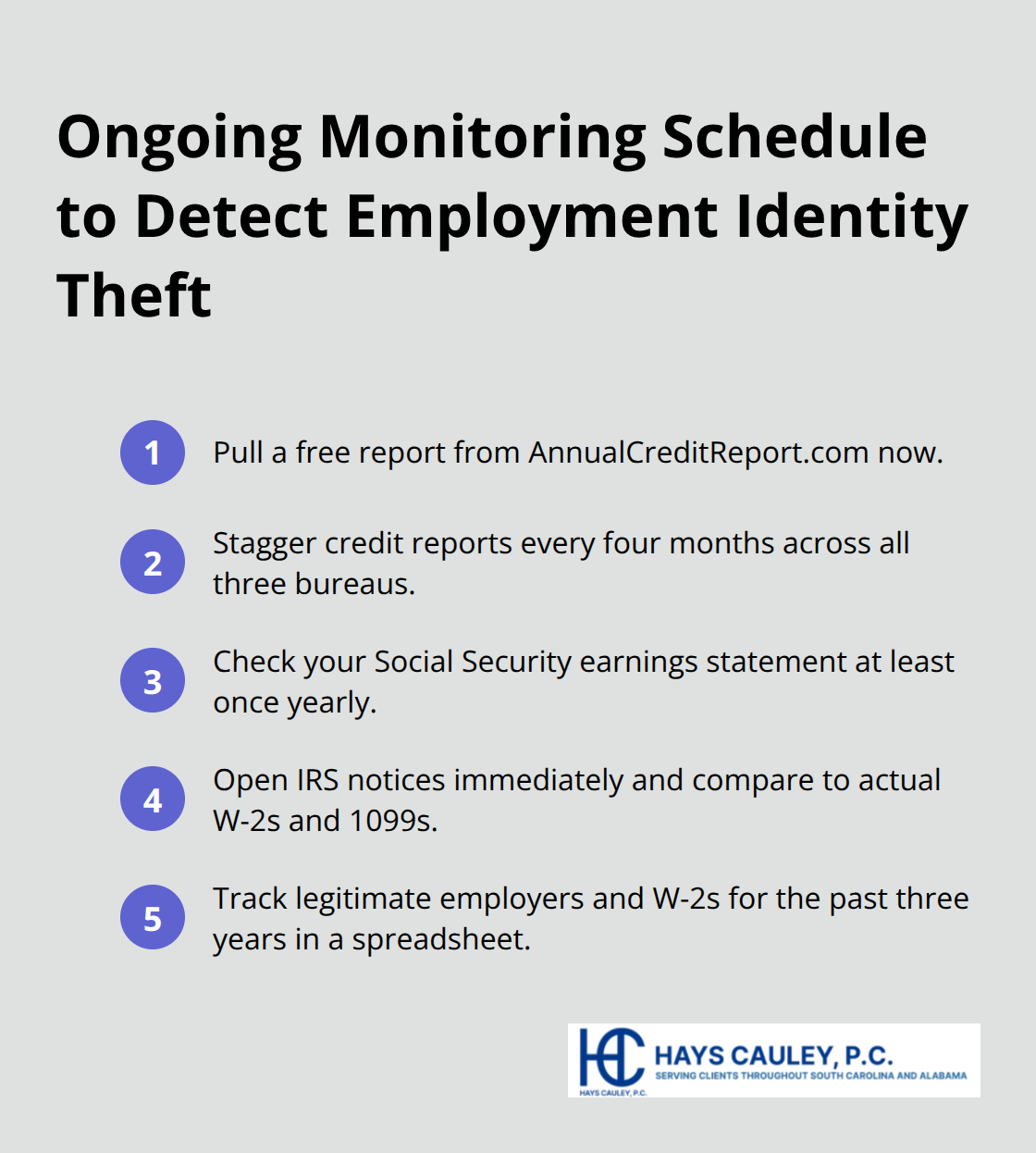
Check your Social Security earnings statement at my Social Security at least once yearly; unfamiliar employers or wage amounts signal immediate problems. The IRS sends notices like CP2000 and CP2057 about income discrepancies, so open tax-related mail immediately and compare it against your actual W-2s and 1099s. Create a spreadsheet tracking all your legitimate employers and W-2s from the past three years, then cross-reference it against any notices you receive.
Strengthen Your Account Security
Multi-factor authentication on your tax and Social Security accounts adds a critical barrier-use it on any online account where you review financial or employment records. Set strong, unique passwords using combinations of uppercase and lowercase letters, numbers, and symbols; password managers like Bitwarden or 1Password generate and store these automatically so you don’t reuse weak passwords across accounts. Never use your SSN, birthdate, or sequential numbers as passwords.
Protect Information at Work and Online
At work, treat colleagues’ personal information the same way you protect your own-don’t discuss SSNs in common areas, lock your computer when stepping away, and never store personal documents on shared drives or unsecured devices. On public Wi-Fi networks, use a VPN service like ProtonVPN or Mullvad to encrypt your internet traffic, preventing criminals from intercepting passwords or financial data transmitted over unprotected connections.
These protective steps form your foundation, but detection matters just as much as prevention. The next section covers what happens when employment identity theft occurs despite your precautions-and how to respond quickly to minimize damage.
What to Do Right Now If Your Identity Is Stolen
Contact the IRS Immediately
Call the IRS Identity Protection Specialized Unit at 1-800-908-4490 the moment you suspect employment identity theft. Have your notice in hand when you call, and answer security questions to verify your identity. The IRS will flag your account and may issue you an Identity Protection PIN, a six-digit code that authenticates you as the legitimate filer and blocks anyone else from filing taxes in your name. Request Form 14039, the Identity Theft Affidavit, only if the IRS directs you to file it; most victims don’t need to submit this form, but the IRS will tell you if you do.
Report the Theft to the Federal Trade Commission
File a report with the Federal Trade Commission at IdentityTheft.gov within 24 hours of discovering the theft. This step generates an Identity Theft Report that you can use when disputing fraudulent information with creditors, employers, and government agencies. The FTC also creates a personalized recovery plan listing every action you need to take, prioritized by urgency.
Alert the Social Security Administration
Call the Social Security Administration at 1-800-269-0271 if your earnings statement shows unfamiliar employers or wages. The SSA can review your record, correct misattributed income, and flag your account for monitoring.
Protect Your Credit Reports
Place a fraud alert on your credit reports by contacting just one of the three major bureaus-Equifax, Experian, or TransUnion-and they legally notify the others. A one-year fraud alert is free and tells lenders to verify your identity before opening new accounts, slowing fraud while you investigate. If you need stronger protection, request a credit freeze, which costs nothing and prevents anyone from accessing your credit report without your explicit permission.
File a Police Report and Monitor Accounts
File a police report documenting the identity theft; this creates an official record you can reference when disputing fraudulent accounts or correcting employment history with the SSA. Monitor your accounts continuously after filing reports because employment identity theft often involves multiple instances of fraud. Check your free annual credit report from AnnualCreditReport.com every four months, review your Social Security earnings statement quarterly at my Social Security, and watch for unexpected tax notices or collection letters.
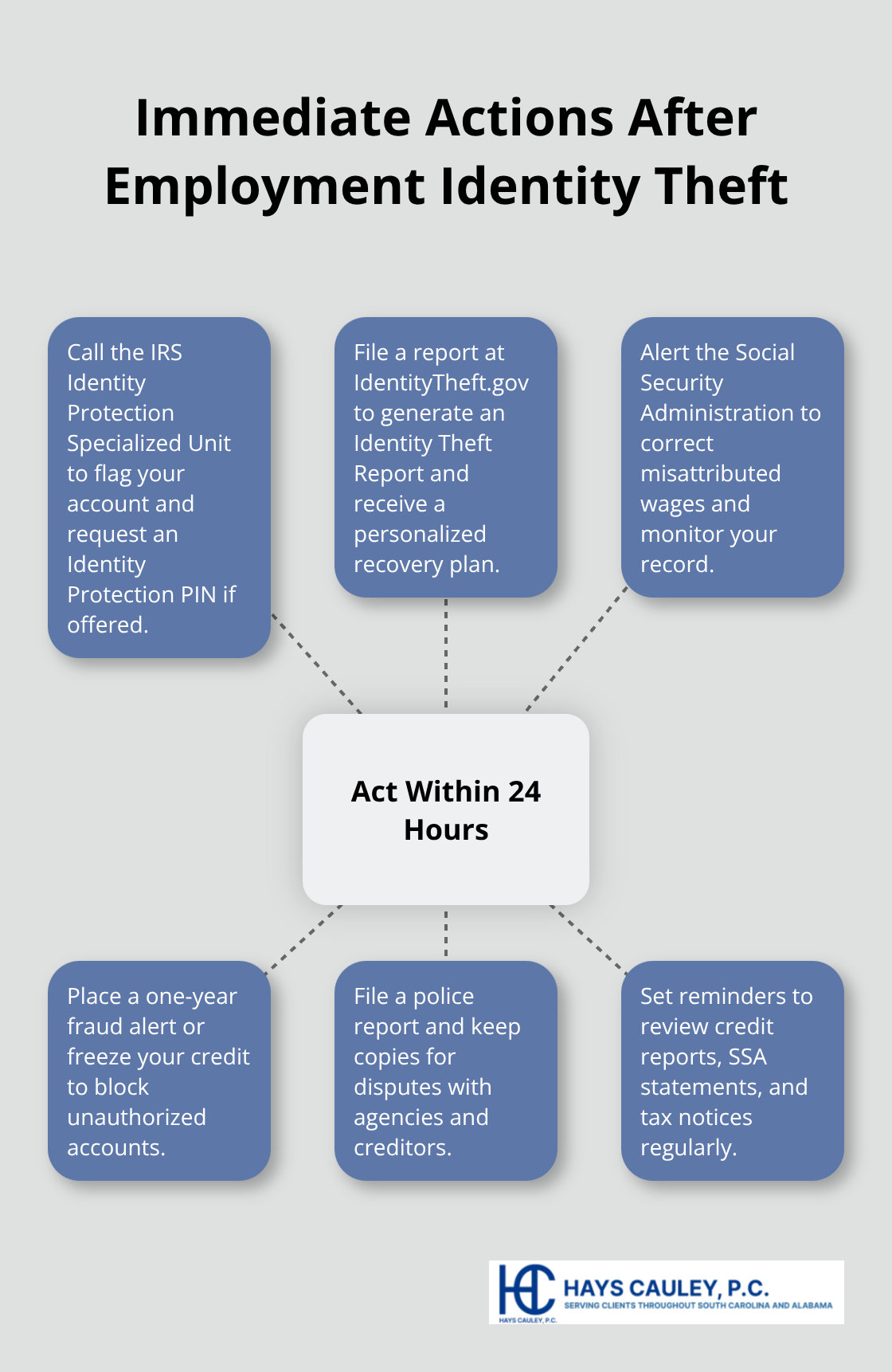
Set calendar reminders for these checks so you don’t forget during recovery’s hectic early weeks. A consumer protection attorney helps you navigate IRS procedures, dispute fraudulent W-2s and 1099s, and recover damages from employers who failed to verify your identity before hiring the thief. An attorney also handles communication with credit bureaus and creditors, removing your burden during an already stressful recovery period. The Federal Trade Commission estimates that identity theft victims spend an average of 16 hours resolving the fraud, but working with legal representation compresses that timeline significantly.
Final Thoughts
Employment identity theft occurs when criminals use your personal information to secure employment in your name, creating cascading problems with your taxes, credit, and Social Security benefits. The damage extends far beyond a single fraudulent job application-it contaminates your employment history, triggers IRS audits, and can reduce your future Social Security benefits. Your protection strategy works best when layered: safeguard your Social Security number by keeping it physically secure, monitor your tax records and credit reports every four months throughout the year, and use strong, unique passwords with multi-factor authentication on accounts containing financial or employment information.
If employment identity theft happens despite your precautions, act within 24 hours by contacting the IRS Identity Protection Specialized Unit at 1-800-908-4490, filing a report with the Federal Trade Commission at IdentityTheft.gov, alerting the Social Security Administration at 1-800-269-0271, and placing a fraud alert on your credit reports. File a police report to create an official record that you’ll need when disputing fraudulent accounts and correcting your employment history. These steps halt further damage and establish documentation that protects your rights throughout recovery.
Recovery from employment identity theft is possible, but it requires persistence and often professional help. We at Hays Cauley, P.C. help South Carolina residents, including those in Greenville, Columbia and Charleston, navigate identity theft recovery by handling communication with government agencies, disputing fraudulent records, and protecting your rights throughout the process. Contact Hays Cauley, P.C. to discuss your situation and learn how legal representation can accelerate your recovery timeline.